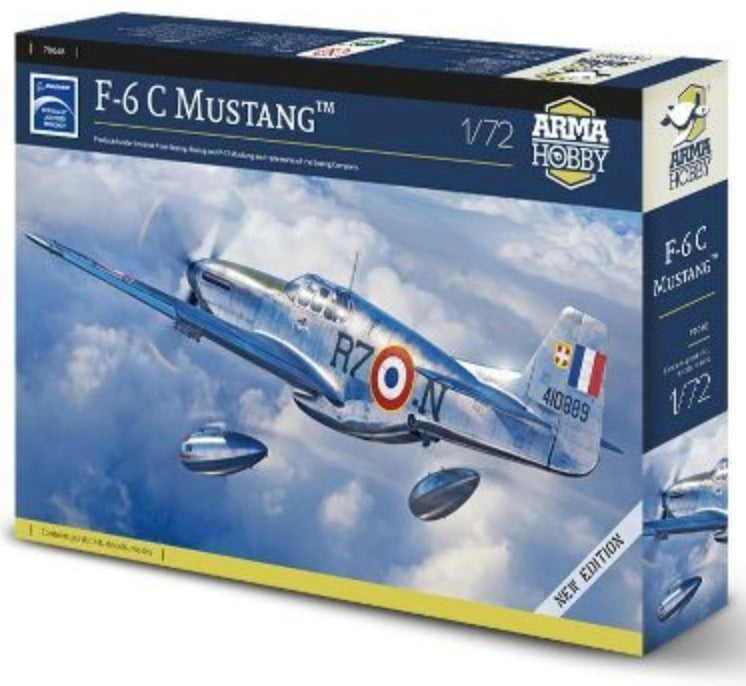
North-American F-6C Mustang™ (new edition of kit, replaced sold out 70040)Kit includes parts needed to build a 1/72 scale model of the F-6C Mustang fighter/photo-reconnaissance aeroplane:plastic partsdecal with 4 marking options (2 USAAF and 1 French)self-adhesive kabuki-paper painting masks for canopy and wheelsMarking Options:F-6C-10-NT Mustang, 44-10889/R7-N, GR II.33 Savoie, French Air Forces, April-May 1945.F-6C-1-NA Mustang, 43-12400/ZM-O, pilot: Cpt. E.B. ‘’Blackie’’ Travis, 12th Tactical Reconnaissance Squadron, 67th Tactical Reconnaissance Group, Middle Wallop, England, spring 1944.F-6C-5-NT Mustang, 42-103604/600, pilot: Maj. E.O. McComas, 118th Tactical Reconnaissance Squadron, 23rd Fighter Group, Chengkung China, October 1944.he legendary P-51 Mustang was an excellent fighter, but it also proved to be a universal photo-reconnaissance plane. Its performance: speed, ceiling, armament, and great range meant that it could efficiently reach a distant target, photograph it and safely return to the base. To become a long-range aerial spy, the Mustang, unlike, for example, the Spitfire, required only the installation of photographic equipment.The reconnaissance Mustang F-6C was a modification of the P-51B/P-51C fighter. Most of the F-6Cs were built at the North-American factories in Dallas and differed from the fighters produced there mainly inthe openings for installing a camera. Photo equipment was installed at modification centers in Love Field and Kansas City. 230 serial F-6Cs were produced this way. In addition, more than 50 P-51B/P-51C fighters were converted into reconnaissance planes in overseas depots and combat units. The reconnaissance Mustangs performed well both for high-altitude missions with a vertical camera and for low-level tactical reconnaissance using an oblique camera. Their armament also allowed them to ?engage in equal combat with enemy planes. They were used by the US Army and Allied Air Force in European, Mediterranean, and Far East theatres of operations.