
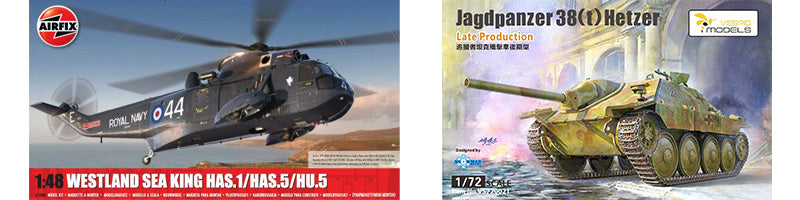
Model Kit Scales Explained: 1:72, 1:48, 1:35, 1:24 & More
Scale is one of the most fundamental concepts in plastic modelling — and one of the most confusing for newcomers. Walk into any model shop and you'll see boxes labelled 1:72, 1:48, 1:35, 1:24, 1:32, 1:144. What do these numbers mean? Which scale is right for aircraft? Which is the standard for tanks? How does the scale you choose affect display size, difficulty, and the models available to you?
This guide explains scale models from first principles — what the ratios mean, how they translate into physical dimensions, which scales work best for which subjects, and how to choose the right scale for your modelling goals, space, and skill level. Browse our full range of plastic model kits at Access Models.
What Is a Scale Model?
A scale model is a physical reproduction of a real object (or fictional subject), built to a consistent ratio that is smaller than the original. Every dimension — length, width, height, the diameter of a wheel, the span of a wing — is reduced by the same factor. This consistency is what makes a scale model different from a toy: every part relates accurately to every other part, just at a reduced size.
The scale ratio is written as a fraction. 1:72 means the model is 1/72nd the size of the real thing. A Supermarine Spitfire with a 36-foot (11m) wingspan would, at 1:72, have a model wingspan of exactly 6 inches (152mm). At 1:48, the same aircraft would have a 9-inch (229mm) wingspan. The number after the colon tells you how many times larger the real object is than the model.
Smaller numbers (1:24, 1:35) mean larger models. Larger numbers (1:72, 1:144) mean smaller models. This seems backwards at first — just remember: 1:35 means 1 unit on the model equals 35 units on the real thing, so everything is 35 times bigger in reality. The smaller the multiplier, the bigger the model.
Why Do Different Scales Exist?
Different scales emerged through a combination of practicality, tradition, and market forces. Aircraft modellers settled on 1:72 because it gives workable sizes for most aircraft while keeping shelves manageable. Military modellers adopted 1:35 partly because it allows figures (which have a natural "unit size" that people can relate to) to look impressive alongside their vehicles. Car modellers gravitated to 1:24 because it produces vehicles of satisfying presence on a shelf.
Some scales are holdovers from early model soldier manufacturing. The "54mm" figure scale, for example, predates the ratio notation system — a 54mm figure corresponds roughly to 1:32. Other scales, like 1:48 for aircraft, gained traction because they halved neatly from a common predecessor scale.
Today, the dominant scales within each subject area are well-established, with manufacturers like Airfix, Tamiya, Revell, Italeri, and Hasegawa producing their ranges to predictable, consistent scales. For a deeper dive into specific kit manufacturers, see our scale model kits guide.
The Most Common Scales Explained
1:72 Scale — The Aircraft Modeller's Standard
1:72 is the most popular scale for aircraft modelling and one of the most widely produced scales overall. It's the standard for WWII and modern military aircraft from virtually every major manufacturer — Airfix, Revell, Italeri, Academy, Hasegawa, and many others all produce extensive 1:72 ranges.
At 1:72, most WWII fighter aircraft (Spitfires, Messerschmitts, Zeros, Mustangs) produce models between 140mm and 200mm long with wingspans of 150mm–250mm. These are comfortable shelf sizes — large enough to show meaningful detail, small enough to display collections without consuming entire rooms. A bookshelf can hold dozens of 1:72 aircraft; the same shelf might hold four or five 1:48 models.
1:72 is also a popular scale for military vehicles and figures, though 1:35 dominates that category. Some naval modelling uses 1:72, and it's the dominant scale for helicopter models.
Best for: Aircraft collections, WWII subjects, beginners wanting manageable sizes, modellers with limited display space.
Leading brands in 1:72: Airfix, Revell, Italeri, Academy, Hasegawa, Eduard (for conversions and photo-etch)
Browse our Airfix range — one of the widest 1:72 selections available.
1:48 Scale — Larger Aircraft, Greater Detail
1:48 is the second major aircraft scale and the choice of modellers who prioritise detail and visual impact over compactness. At 1:48, a Spitfire grows from roughly 185mm (1:72) to around 274mm long — a more substantial, impressive presence. The larger size means panel lines, rivets, cockpit detail, and surface textures can all be more finely reproduced and more easily painted.
Tamiya's outstanding 1:48 aircraft range has become the benchmark for quality in the scale. Their WWII subjects — Spitfires, Zeros, Mustangs, B-17s, and many others — set standards for fit and accuracy that competitors continue to chase. Italeri, Eduard, and Revell also produce strong 1:48 ranges.
The practical downside of 1:48 over 1:72 is display space. Large WWII bombers (B-17, Lancaster, B-29) at 1:48 are enormous models — a 1:48 B-17 Flying Fortress has a wingspan of nearly 700mm. Fascinating to build, but requiring dedicated display space.
Best for: Modellers who want maximum cockpit detail, larger fighters and WWII subjects, intermediate to advanced builders.
Leading brands in 1:48: Tamiya, Eduard, Italeri, Revell, Airfix (selected subjects)
1:35 Scale — The Military Modeller's Standard
1:35 is the dominant scale for military armour — tanks, armoured fighting vehicles, artillery, trucks, half-tracks, and the figures that crew and accompany them. Tamiya essentially established 1:35 as the standard in the 1960s when they introduced their Military Miniatures series, and the scale has been dominant ever since.
At 1:35, a WWII German Tiger I tank (which in reality weighed 57 tonnes and was over 8 metres long) produces a model approximately 240mm long. The scale provides enough room to model internal engine detail, stowage, crew figures with realistic proportions, and the complex running gear that makes tank models so compelling to build.
1:35 scale figures are 51–54mm tall (representing a 6-foot man). This is large enough to paint convincingly with facial expression, fabric folds, and equipment markings — an important consideration since figure painting is a significant part of armour modelling.
The downside: 1:35 models of large vehicles are genuinely large. A 1:35 Panzer VI Tiger I is about as big as a large hardback book. Display cases fill up quickly, and the most complex kits (particularly German WWII subjects from Tamiya, Dragon, Zvezda, or Border Model) involve hundreds of parts and many hours of construction.
Best for: WWII and modern armour, military dioramas, figure modelling, experienced builders.
Leading brands in 1:35: Tamiya, Dragon, Zvezda, Revell, Border Model, Academy, Italeri, MiniArt
Browse our military model kits — Tamiya's 1:35 range is a particular strength.
1:32 Scale — Large Aircraft and Some Armour
1:32 is a large scale used primarily for aircraft, producing models with exceptional presence and detail potential. A Spitfire at 1:32 has a wingspan of approximately 380mm — getting on for a foot and a half. The cockpit alone can accommodate extremely fine detail: instrument panels with individual switches, gunsight glass, pilot figures with painted faces.
Revell, Hasegawa, Trumpeter, and a few specialist manufacturers produce 1:32 aircraft. The scale commands premium prices due to the complexity and material volume of the kits, but for the serious aircraft modeller who wants to build one or two exceptional subjects rather than a large collection, 1:32 is unbeatable for impact.
Best for: Display pieces, experienced modellers, aircraft enthusiasts building one spectacular model.
1:24 and 1:25 Scale — Cars and Trucks
These two scales are very close (1:24 produces a slightly larger model than 1:25 — negligible in practice) and are virtually interchangeable for car modelling purposes. They're the dominant scales for model car kits, produced by Tamiya (1:24 predominantly), Revell, Italeri, Aoshima, and Fujimi.
At 1:24, a typical saloon car (4 metres long in reality) produces a model about 165mm long. Sports cars and supercars are correspondingly stunning — a 1:24 Ferrari 250 GTO or Lamborghini Countach is an object of genuine beauty. The scale is large enough to model opening bonnets, detailed engine bays, interior cockpits, and working suspension.
1:24/25 scale figures are approximately 70mm tall, which is large enough to paint highly convincingly. Driver figures and pit crew for racing car models are a natural companion subject.
American kit manufacturers Revell and AMT traditionally work in 1:25, while European and Japanese manufacturers prefer 1:24. The difference is trivial for display purposes.
Best for: Car enthusiasts, racing subject, supercar models, diorama scenes.
Leading brands in 1:24/25: Tamiya, Revell, Italeri, Aoshima, Fujimi
1:144 Scale — Tiny Aircraft and Spacecraft
1:144 is a small scale used for very large aircraft (where 1:72 would produce an unmanageably large model) and spacecraft. A Boeing 747 at 1:144 is about 430mm long — manageable. At 1:72, it would be nearly a metre. 1:144 is also used for some figure sets and naval subjects. It's a niche scale but serves a clear purpose for large subject modelling.
1:350 and 1:700 Scale — Naval Modelling
Naval modelling has its own distinct scale conventions. 1:350 is the dominant modern warship scale — a 300-metre destroyer at 1:350 produces an 860mm model. 1:700 is a smaller alternative, widely used in Japan (Waterline series). These scales allow modellers to represent entire fleet subjects in reasonable physical sizes while retaining enough detail to paint convincingly.
Scale Comparison: Real vs Model Dimensions
To make the scales concrete, here's how a standard military figure (nominally 6 feet / 1.83 metres tall) appears at different scales:
| Scale | Figure Height | Typical Use | Display Size (Spitfire) |
|---|---|---|---|
| 1:144 | ~12mm | Large aircraft, spacecraft | ~65mm wingspan |
| 1:72 | ~25mm | Aircraft, armour, general | ~185mm wingspan |
| 1:48 | ~38mm | Aircraft, some armour | ~275mm wingspan |
| 1:35 | ~52mm | Military armour & figures | ~380mm wingspan |
| 1:32 | ~57mm | Large aircraft, display pieces | ~380mm wingspan |
| 1:24 | ~76mm | Cars, trucks | N/A (not standard) |
Which Scale for Which Subject?
Aircraft Models
Most popular: 1:72 (largest range, most affordable, most widely available) and 1:48 (more detail, Tamiya's exceptional range).
For large aircraft (bombers, airliners): 1:72 becomes challenging in physical size. 1:144 is sometimes more practical for 4-engine bombers.
For show-stopping display pieces: 1:32, particularly Revell's large scale Spitfire or Hasegawa's 1:32 range.
Airfix's 1:72 range covers an enormous breadth of subjects at accessible prices, making them the go-to for beginners and collectors alike. Their 1:48 range has improved significantly in recent years.
Military Armour (Tanks and AFVs)
Standard scale: 1:35 — by a very wide margin. Tamiya's Military Miniatures series defined the scale and it remains dominant. Dragon, Zvezda, Revell, Academy, and MiniArt all produce strong 1:35 ranges.
Smaller option: 1:72 armour is available (Revell, Airfix, Italeri, Zvezda produce some excellent small-scale subjects) and works well for modellers wanting a manageable collection size.
Diorama work: 1:35 is the standard for military dioramas — the figure size is large enough to paint convincingly, and the vehicle size creates impressive scene-setting.
Cars and Road Vehicles
Standard scale: 1:24 (European and Japanese manufacturers) and 1:25 (American manufacturers, particularly Revell USA and AMT). These are effectively interchangeable for display.
Smaller car models: 1:43 diecast cars exist alongside plastic kits, and some manufacturers produce 1:64 (roughly the scale of Hot Wheels) kits.
Trucks and large commercial vehicles: 1:24 produces very large models of semi-trucks — accurate and impressive, but requiring significant display space.
Ships and Naval Subjects
Standard scales: 1:350 for modern warships (manageable yet detailed), 1:700 for smaller models and collections. 1:350 is particularly well-served by Tamiya, Hasegawa, and Dragon. 1:700 is the traditional Japanese scale (Waterline series).
Historical sailing ships: Often produced at unusual scales (1:96, 1:150, 1:200) to manage the complex rigging and spars of tall ships at practical sizes.
Figures and Soldiers
Standard scales: 54mm (1:32), 75mm (approximately 1:22), and 90mm (approximately 1:20) for display figures painted individually. 1:35 figures (52mm) for armour dioramas. 1:72 (25mm) for historical wargaming miniatures.
Choosing the Right Scale: Practical Considerations
Display Space
Be honest about how much room you have. A 1:48 aircraft collection can occupy a lot of shelf space quickly. A collection of 1:72 models takes significantly less room per kit. If you're building for display, sketch out your available shelving and calculate how many models of each scale you could realistically display — this often settles the scale question definitively.
Detail Level vs Difficulty
Larger scales (1:35, 1:24, 1:32) offer more surface for detailed painting but also involve more parts, more complex construction, and higher expectations for the finished result. A mediocre paint job is less visible at 1:72 than at 1:35. Beginners often find 1:72 more forgiving — but equally, the smaller scale demands steadier hands for cleanup and basic painting.
A good starting point for most beginners: a 1:72 aircraft kit or a 1:35 tank from Tamiya (their entry-level kits are exceptionally well-engineered with minimal frustrating fit issues). For cars, Tamiya's 1:24 range offers excellent engineering that makes them accessible even for first-time builders.
Budget
Scale and price are broadly correlated — larger scales use more material and typically command higher prices. A 1:72 Airfix Spitfire costs around £10–£15. The equivalent 1:48 kit is £20–£35. A 1:32 showpiece might be £80–£120. Budget modellers get excellent value at 1:72; premium modellers building showcase pieces tend toward 1:48 and above.
Subject Availability
Some subjects exist in only one or two scales. If you specifically want to model a Lockheed SR-71 Blackbird, check what scales it's available in before deciding on your scale system — the availability of your preferred subjects should influence your scale choice more than abstract preference.
Use our scale model kits guide to understand what's available across different categories.
Mixing Scales: When It Works and When It Doesn't
Many modellers collect at multiple scales — aircraft in 1:72 alongside armour in 1:35 alongside cars in 1:24. This is entirely valid; the scales aren't expected to be compatible with each other in the way that model railway gauges are. A collection of different subject types naturally lives at different scales.
Where mixing creates problems: dioramas. If you're building a scene with a tank, a truck, and figures, everything must be at the same scale. A 1:35 figure next to a 1:72 tank looks absurd. Always check scale compatibility when building combined-subject dioramas.
Frequently Asked Questions: Model Kit Scales
What does 1:72 mean on a model kit?
It means the model is 1/72nd the size of the real object. Every dimension is reduced by a factor of 72. A 72-metre ship would be 1 metre as a model. A 9-metre aircraft would be 125mm long. The ratio is consistent across every part of the model — that's what makes it a true scale model.
What scale do most beginners start with?
For aircraft, most beginners start with 1:72 — it's the most affordable, has the widest range of subjects, and produces manageable sizes. Airfix's 1:72 Starter Sets are specifically designed for newcomers. For armour, Tamiya's 1:35 MM series offers excellent beginner-friendly kits. For cars, Tamiya's 1:24 range is hard to beat for engineering quality and accessible build complexity.
Is 1:35 bigger than 1:72?
Yes — a lower denominator means a larger scale. 1:35 models are larger than 1:72 models. A 1:35 model is approximately twice the linear size of the equivalent 1:72 subject (72 ÷ 35 ≈ 2.06). In practice, a 1:72 tank might be 120mm long; the same tank at 1:35 would be around 240mm long.
Which scale is most popular?
Across all subjects, 1:72 probably produces the largest number of individual kits in production worldwide (driven by aircraft and light armour). Within specific subject areas: 1:72 dominates aircraft; 1:35 dominates military armour; 1:24/25 dominates cars. 1:35 Tamiya kits are among the best-selling plastic model kits globally.
Do I need special tools for larger scales?
The fundamental tools are the same at all scales — sprue cutters, sanding sticks, hobby knife, paints and brushes. Larger scales may benefit from larger brushes for base coats. Very small scales (1:144, 1:700) may require magnification for detail work. Most modellers find their existing tools work across their chosen scale range with no additional purchases required.
Shop Plastic Model Kits at Access Models
Access Models stocks plastic model kits across all major scales from Airfix, Tamiya, Revell, Italeri, and more. Whether you're starting your first build or adding to a specialist collection, browse our complete range of model kits. For paints, adhesives, and modelling tools, see our paints and supplies range.