
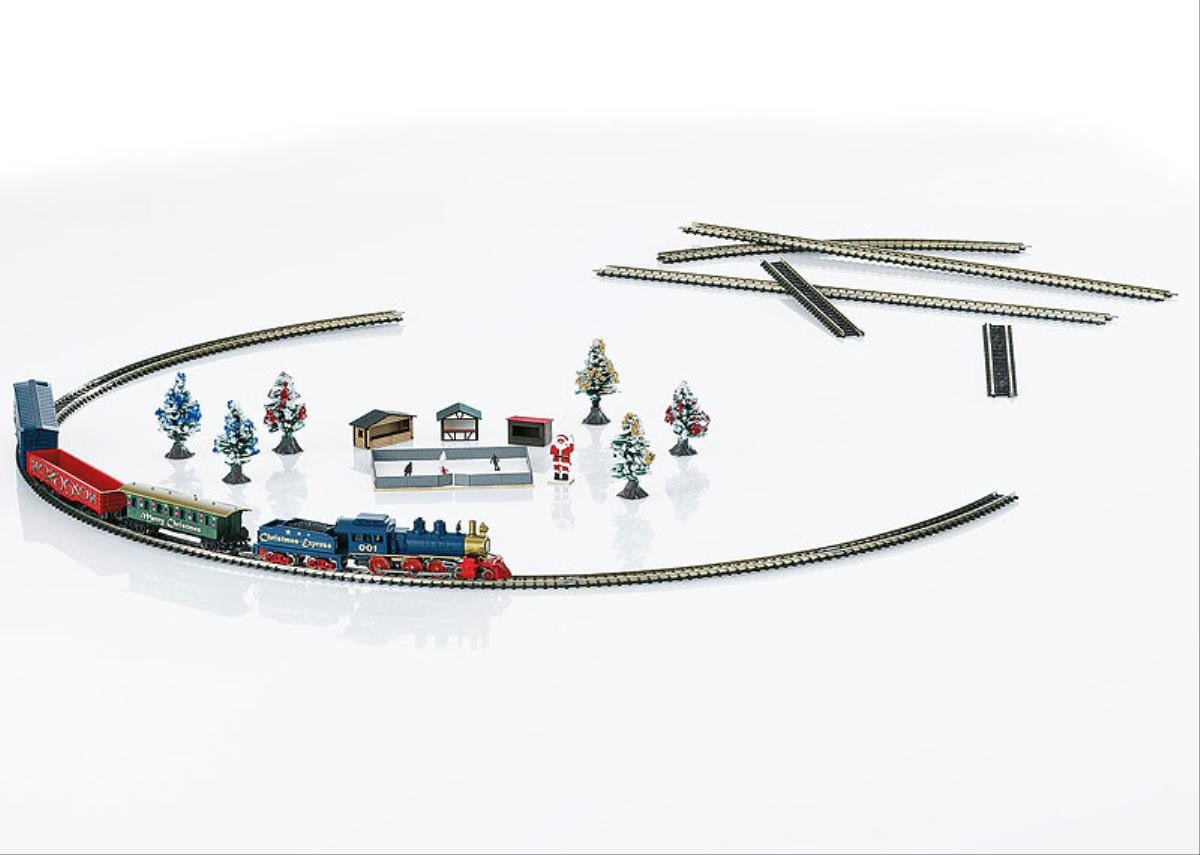
Model Railway Layout Ideas for Small Spaces
One of the most common questions we hear from new railway modellers is: "I haven't got room for a proper layout — is it even worth starting?" The answer is an emphatic yes. Some of the most impressive model railway layout ideas we've ever seen have come from small spaces — a spare bedroom corner, a shelf along a wall, a fold-out board in a garage. The constraint of limited space often forces more creative, focused layouts that end up being far more satisfying than sprawling, half-finished empires. Here's how to make the most of what you've got.
Scale First: Why N Gauge is King for Small Spaces
Before you plan anything, choose your scale. This decision determines everything — the minimum curve radius you need, how much scenery you can fit, the level of detail available.
N Gauge (1:148 / 1:160)
N gauge is the go-to choice for small spaces, and for good reason. At roughly half the size of OO gauge, N gauge lets you fit twice the layout in the same footprint. A continuous run oval that would need a 6x4 board in OO fits comfortably on a 4x2 board in N gauge. Minimum curve radius for N gauge is around 228mm, compared to 438mm for OO second radius curves.
The N gauge range has expanded enormously in recent years. Dapol, Graham Farish (Bachmann), and Farish are the main British N gauge manufacturers, and the range of locos, rolling stock, and buildings available is genuinely impressive. Don't be put off by the smaller size — with modern manufacturing, N gauge models are beautifully detailed.
OO Gauge (1:76)
OO is the British standard and has the largest range of models, accessories, and scenic products available. If you have a minimum of a 4x2 board (roughly 1200x600mm), you can run a basic OO oval. It's tight, but doable. A 6x2 shelf gives you much more to work with.
Browse our full model railway range including N gauge and OO gauge locomotives, rolling stock, and accessories.
The Best Small Layout Ideas
1. The Shelf Layout
The shelf layout is the single best solution for small spaces. A shelf 30-40cm deep and as long as your wall allows (2-4 metres is ideal) gives you a surprisingly usable footprint. The key is to design as a point-to-point layout rather than a continuous run — trains travel from one terminus or fiddle yard to another, just like real railways.
A classic shelf layout structure:
- One end: small terminus station (2-3 platforms)
- Middle: scenic section (countryside, cutting, viaduct)
- Other end: fiddle yard (hidden staging area where you swap trains around)
This approach means you can have realistic train movements, interesting scenery, and operational interest — all on a shelf that folds up or stores flat against the wall.
2. The 4x2 Continuous Oval (N Gauge)
The 4x2 board (1200x600mm, a standard sheet of plywood cut down) is the most common small layout format. In N gauge, you can fit a complete continuous oval with a passing loop, station, goods yard, and small scenic section in this space. It's genuinely impressive what experienced modellers achieve on 4x2.
A standard 4x2 N gauge layout might include:
- Inner and outer running loops
- A small station with two platforms
- A goods shed siding
- Compact scenic area (cutting, embankment, or country lane)
3. The Inglenook Shunting Puzzle
No space for a continuous run at all? The inglenook is a classic. It's a small shunting layout — typically 60-90cm long — designed around a specific switching puzzle: arrange wagons into the correct order using only a small number of moves. It sounds simple, but experienced operators find inglenooks genuinely absorbing and operationally challenging.
The classic inglenook consists of three sidings: one holding 5 wagons, one holding 3, and one holding 3, with a locomotive. The puzzle is to arrange five selected wagons in a specific order. There are thousands of possible configurations. This is a perfect layout for a coffee table, a small shelf, or even a portable exhibition layout.
4. The Fold-Away / Hinged Layout
If you share the room with non-railway activities, a fold-away layout is the answer. Build your layout on two boards hinged together so it folds flat against the wall — or on legs that fold down for storage. Some modellers build layouts on the back of a door. Others use a Murphy-bed style mechanism with the layout facing out when in use and folding up when not.
This requires some carpentry, but the payoff is a full-sized layout that genuinely disappears when not in use. A 4x4 OO gauge layout can fold to a 2x4 panel and lean against the wall.
5. The Baseboard Extension Method
Start with a single 4x2 or 6x2 module and design it so it can accept additional boards later. Each board has a standardised connection point for track and wiring. This way, your small layout grows with your available space — add a board when you move house, redecorate, or reclaim the spare room. Keep the connection points consistent and you'll build a modular masterpiece over years.
Track Planning for Small Layouts
Good track planning is the difference between a layout that frustrates you and one that runs reliably and looks great. Key principles:
- Use the largest curves your space allows — tight curves cause derailments, look unrealistic, and limit loco length. If you can fit second-radius curves (438mm for OO), do it. Third radius is even better.
- Plan gradients carefully — any gradient over 1:50 will slow heavy trains. Keep gradients gentle or avoid them entirely on small layouts.
- Avoid S-curves — two consecutive curves in opposite directions without a short straight between them cause derailments. Always put at least a short straight section between opposing curves.
- Leave access points — you need to reach every part of your layout to rerail stock, clean track, and fix problems. Don't build scenery you can't reach over.
Scenery Ideas for Small Layouts
Great scenery transforms a small layout into something that looks like a model of a real place. Some of the most effective techniques for small spaces:
The Forced Perspective Backdrop
Paint a sky-and-landscape backdrop on the wall or a board behind your layout. Add a printed photographic backdrop for distant hills, fields, or townscapes. As the eye moves from the detailed foreground to the painted background, the sense of depth increases enormously. This is one of the most powerful tricks in small layout design.
Maximum Scenic Density
On a small layout, every square inch of scenery needs to earn its place. Don't leave bare baseboard — plant trees right to the edges, add fencing, scatter figure groups, place parked vehicles. Busy, detailed scenes look larger than empty ones.
Scenic Dividers
Use hills, cuttings, tunnel mouths, or rows of buildings to break up the view and hide the fact that the track loops around. If you can't see the whole layout at once, it feels larger. A tunnel through a hill is one of the oldest tricks in railway modelling — and it still works.
Browse our model railway scenery and railway buildings at Access Models.
Fiddle Yards — The Small Layout's Best Friend
A fiddle yard is a hidden staging area where you manually swap trains in and out of the scenic section. On a shelf layout, one end is often enclosed or hidden and serves as a fiddle yard. This allows you to run different trains on the same layout — a freight train disappears into the fiddle yard and reappears as a passenger express a moment later. Operationally, a fiddle yard multiplies the interest and variety of a small layout enormously.
Simple fiddle yard designs include:
- Cassette fiddle yard — removable track sections (cassettes) that can be swapped out
- Sector plate — a rotating board with multiple tracks that aligns with the entry track
- Traditional fan — multiple sidings fanning off a headshunt, manually shunted
Frequently Asked Questions
What is the smallest model railway layout you can build?
An inglenook shunting layout can be built in as little as 60cm of length in N gauge. A simple oval in N gauge fits on a 4x2 board (1200x600mm).
What scale is best for a small model railway layout?
N gauge (1:148 in Britain) is best for small spaces — roughly half the size of OO gauge, letting you fit twice as much layout in the same footprint.
How do I plan a model railway layout?
Start with your available space and scale, then use free software like AnyRail or XtrkCad to experiment with track arrangements before buying anything.
What is a fiddle yard in model railways?
A fiddle yard is a hidden staging area where you manually swap trains out of view of the scenic section — allowing you to run multiple trains on a small layout.
Can I build a model railway in a small bedroom?
Absolutely. A shelf layout, fold-away board, or compact 4x2 N gauge layout are all excellent options for small bedrooms.
Find everything you need for your layout at Access Models' model railway department — locomotives, track, buildings, scenic materials and more, delivered fast across the UK.